
Updated on
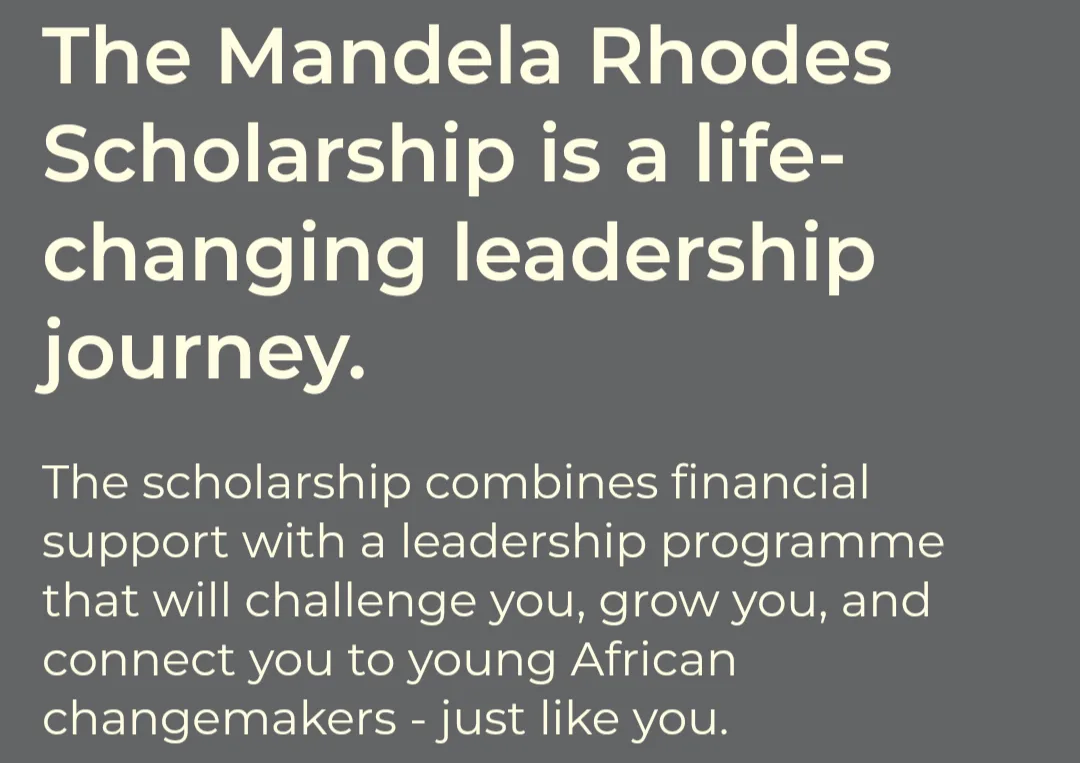
The Mandela Rhodes Scholarship pays for African citizens aged 19 to 29 to study a one-year Honours degree or a two-year Master’s degree in any field at a recognised South African university, and it adds a leadership development programme on top of the funding. You need an undergraduate degree with excellent results, which the Mandela Rhodes Foundation defines as above 70% or upper-second class Honours, by 1 January of the intake year. The Foundation’s current page lists 9 March 2027 as the opening date for applications for the Class of 2028.
Mandela Rhodes Scholarship at a glance
| Question | Answer |
|---|---|
| Who can apply | Citizens of any African country who can study at postgraduate level in English |
| Age | Between 19 and 29 in the year you apply |
| Academic result | An undergraduate degree with results above 70% or upper-second class Honours, completed by 1 January of the intake year |
| What is funded | A one-year Honours degree or a two-year Master’s degree in any field |
| Where you study | A recognised institution of higher education in South Africa, in person (distance learning is not allowed) |
| Leadership programme | Compulsory, delivered through residential workshops plus online gatherings |
| Application window | March to November each year, for the following year’s intake |
What the Mandela Rhodes Scholarship covers
The Foundation describes the award as comprehensive funding for the core costs of your studies. It lists the following items:






















📌 Read More
- Tuition and registration fees for the Honours or Master’s degree
- Allowances for study materials, research and medical aid
- Accommodation and meals
- A personal allowance
- Economy class travel between your home country and your South African university at the beginning and end of the degree
The award does not fund undergraduate study. Read the Foundation’s own list of costs that are not covered before you plan your budget, because items outside the core costs stay your responsibility.
Who qualifies: the requirements in plain terms
- You can study at postgraduate level in English.
- You are a citizen of an African country.
- You are between 19 and 29 in the year you apply.
- By 1 January of the intake year you will hold an undergraduate degree with excellent results, above 70% or upper-second class Honours.
The Foundation also asks you to aspire to be an ethical leader committed to equality, freedom and human dignity in Africa, to admire Nelson Mandela’s ability to bring people together, and to be ready to reflect on your own leadership and grow through the process. These are part of how applicants are judged, so they deserve as much preparation as your transcript.
How selection works: four principles
| Principle | What the Foundation looks for |
|---|---|
| Leadership | Leadership seen as a way to advance equality, freedom, human rights and human dignity, not only personal ambition |
| Reconciliation | Willingness to look at your own internal landscape and work toward a more just world |
| Education | Excellent academic results together with a belief that your education should make a difference for others |
| Entrepreneurship | Individual effort, innovation and creativity aimed at helping Africa take its place as an equal and competitive presence |
Conditions that apply once you are selected
- You must attend and take part in the leadership programme. There are three workshops in the first year and two in the second year of a two-year degree.
- You must accept the scholarship for the year it is offered. It cannot be deferred.
- You must have secured admission to your university of choice by January of your year in residence.
- You may not hold other scholarships or funded opportunities.
- You may not do paid work for more than 12 hours a week.
- Travel outside South Africa, even for research, is not accepted as a reason to miss programme activities.
- You must keep high standards of work and conduct, and complete the feedback forms the Foundation sends.
For applicants from Nigeria and other countries outside South Africa
Most of the extra work for non-South African applicants happens around the university stage, not the scholarship form. Plan for these points early:

- Entry level. Many South African master’s programmes expect a four-year degree or an Honours degree. The Foundation says that if you do not qualify for a master’s programme you could apply for an Honours programme instead.
- Qualification checks. Applicants from outside South Africa may need verification by SAQA, the South African Qualifications Authority, before they can start at a South African university. Read the Foundation’s FAQ on when to apply for it.
- Passport. The application asks for a copy of your passport, so start the passport process well before the March opening date if you do not hold one.
- Visa. Check what help the Foundation offers with study visas and follow South Africa’s own student visa rules for your country.
Application calendar
| Stage | What to do |
|---|---|
| Before March | Check eligibility, choose South African universities and courses, start passport, transcript and qualification checks |
| March | Applications open online through the Foundation’s platform (9 March 2027 for the Class of 2028) |
| March to November | Applications, selection and the university admission process run through this window |
| By January of your year in residence | Admission to your university must be secured |
Always read the live timeline on the Mandela Rhodes Foundation application page, because dates and rules are set for each intake.
Mistakes that cost applicants a place
- Assuming a result of exactly 70% qualifies when the rule says above 70%.
- Planning to finish your undergraduate degree after 1 January of the intake year.
- Planning online study from home, which the scholarship does not allow.
- Counting on a second scholarship or a part-time job above 12 hours a week while on the award.
- Treating the leadership questions as an afterthought when they are a core part of selection.
- Relying on an old year’s page for dates, age limits or funding items instead of the current one.
Where to go next
- Follow the full process in how to apply for scholarships as a Nigerian student.
- Compare other ways to pay in how Nigerians can fund study abroad.
- Learn what the label means in what a fully funded scholarship covers and how to check it.
- Weigh your destination options with the comparison of countries to study and work abroad.
- Check the wider case for going abroad in why study abroad: benefits, costs and trade-offs.
Frequently Asked Questions




👀 You Missed
You Might Also Like







No responses yet