
Updated on
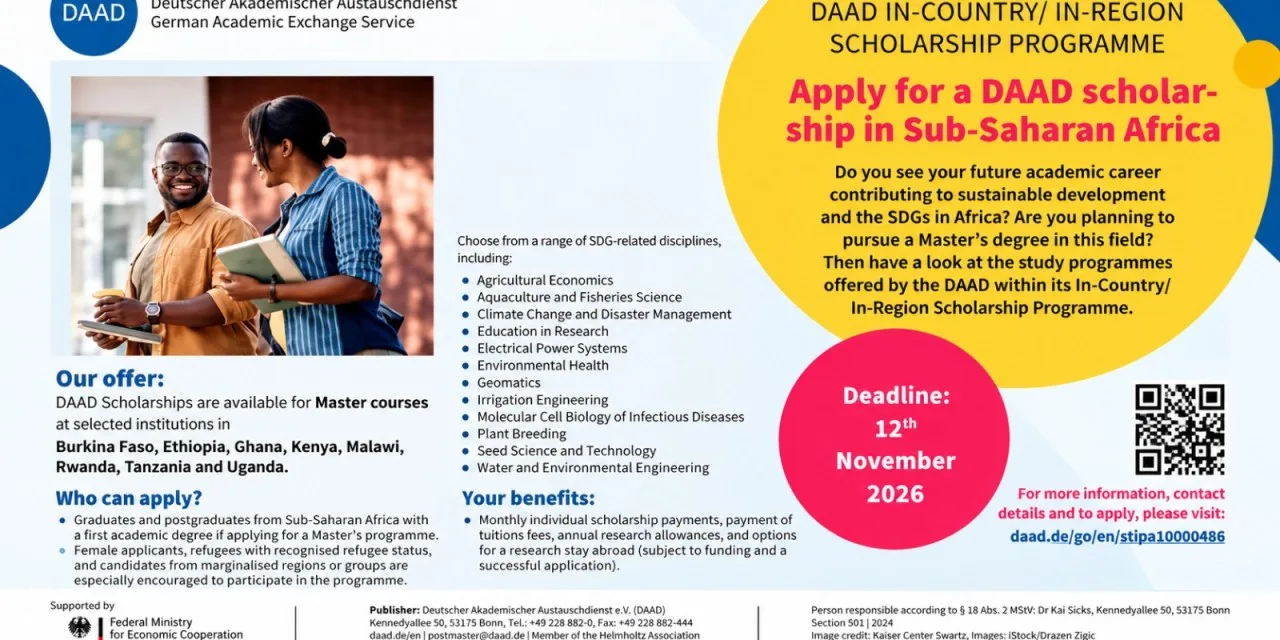
The DAAD In-Country/In-Region Programme funds graduates from Sub-Saharan Africa to study a Master’s degree at a selected African university, either in their own country (In-Country) or in another country in the region (In-Region). It is aimed at people who plan a career in teaching or research at a higher education institution in Sub-Saharan Africa. You apply for a specific degree programme at a host university, following the call for that programme.
In-Country and In-Region Compared
| Item | In-Country | In-Region |
|---|---|---|
| Where you study | A host university in the country you apply from | A host university in another Sub-Saharan African country |
| Monthly scholarship | Yes | Yes |
| Study and research allowance | Yes | Yes |
| Thesis publishing costs | Yes | Yes |
| Tuition fees | Yes | Yes |
| Travel allowance | No | Yes |
| Health insurance | No | Yes |
Funding covers the regular length of the course, generally up to two years. Exact monthly amounts are set in the call for each degree programme, so read that call before you budget.





















📌 Read More
Who Can Apply
- Graduates and postgraduates from Sub-Saharan Africa who hold a first academic degree.
- Applicants who plan to teach or do research at a higher education institution in Sub-Saharan Africa.
- Women, refugees with recognised refugee status, and candidates from marginalised regions or groups are especially encouraged to apply.
- Applicants choose their country of residence in the online form. Nigeria is one of the countries on the list.
Host Universities and Degrees on the Current List
The programme only funds the degrees listed for each host university. This is the list shown for the current call.
| Country | Host university | Degree |
|---|---|---|
| Burkina Faso | 2iE | MSc Water and Environmental Engineering |
| Ghana | University of Ghana (WACCI) | MPhil Seed Science and Technology |
| Ghana | University of Ghana (WACCBIP) | MPhil Molecular Cell Biology of Infectious Diseases |
| Ghana | University for Development Studies | MPhil Agricultural Economics |
| Ethiopia | Jimma University | Master in Environmental Health |
| Kenya | Chuka University | MSc Plant Breeding |
| Kenya | Moi University | Master of Education in Research |
| Rwanda | University of Rwanda | MSc Electrical Power Systems |
| Tanzania | Ardhi University | MSc Geomatics |
| Uganda | Busitema University | MSc Climate Change and Disaster Management |
| Malawi | MUBAS | MSc Environmental Health |
| Malawi | LUANAR | MSc Aquaculture and Fisheries Science; MSc Irrigation Engineering |
None of the host universities on this list is in Nigeria, so a Nigerian applicant would be looking at In-Region study in countries such as Ghana, Kenya, Rwanda or Malawi.
Choosing a Programme by Background
| If your first degree is in | Programmes worth checking |
|---|---|
| Agriculture, biology or plant science | Seed Science and Technology, Plant Breeding, Agricultural Economics, Aquaculture and Fisheries Science |
| Engineering | Water and Environmental Engineering, Electrical Power Systems, Irrigation Engineering |
| Health or life sciences | Environmental Health, Molecular Cell Biology of Infectious Diseases |
| Geography, surveying or environment | Geomatics, Climate Change and Disaster Management |
| Education | Master of Education in Research |
Step by Step: How to Apply
- Pick the degree programme and host university that match your first degree and career plan.
- Open the DAAD scholarship database page for the programme and read the call for that degree. Requirements and selection steps differ between programmes.
- Prepare your documents as the call lists them, for example certificates, transcripts, a CV and a statement of purpose.
- Select your status and country of residence in the DAAD application portal. A desktop computer works best for the form.
- Submit before the closing date in the call. For the current round it is 12 November 2026.
Common Mistakes
| Mistake | Better approach |
|---|---|
| Applying without reading the programme call | Each degree has its own rules, so read the call first |
| Choosing a degree outside the list | Only the listed degrees at the listed hosts are funded |
| Assuming the scholarship is for study in Germany | This route funds study at African universities |
| Leaving the application to the last day | Prepare documents early so upload problems do not block you |
Frequently Asked Questions
Is this for Master’s or PhD study?
The programmes on the current list are Master’s level (MSc, MPhil and Master). Check the individual call before assuming a doctoral option exists.

Do I need to move to Germany?
No. The scholarship funds study at African host universities. DAAD is the German Academic Exchange Service, which pays for the programme.
Who gets a travel allowance and health insurance?
These are listed for In-Region scholarship holders, meaning students who study in another country in the region.
📰 Similar Posts
How long does funding last?
It covers the regular length of the Master’s course, generally up to two years.
Is there an application fee?
Check the call for your programme. The programme page does not list a fee, and you should not pay anyone to submit the application for you.
Where is the official page?
The official listing is in the DAAD scholarship database: DAAD In-Country/In-Region Programme, Sub-Saharan Africa.




👀 You Missed
You Might Also Like





No responses yet