
Updated on
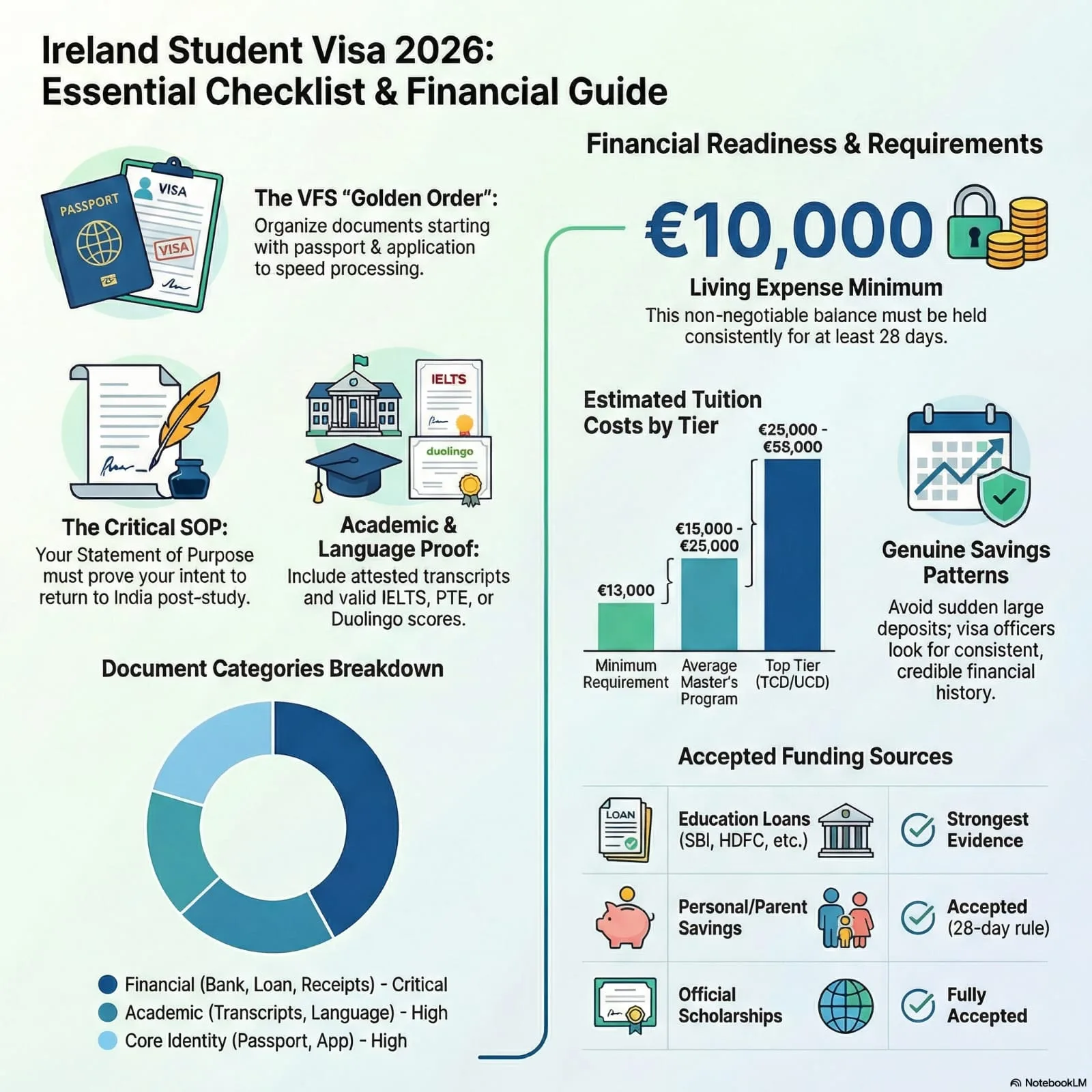
For an Ireland student visa, you must show immediate access to at least €10,000 for living costs in your first academic year, and the same level of funds for each later year plus that year’s course fees. Shorter courses use €833 per month of stay, up to a maximum of €6,665. The visa fee is €60 for a single-entry visa. This guide covers the Ireland student visa requirements for African students who plan to study in Ireland: the funds rule, the evidence that counts, the document checklist and the steps to apply through Ireland’s Immigration Service Delivery (ISD).
Ireland Student Visa Requirements at a Glance
| Item | What applies |
|---|---|
| Living funds, first year (courses over 8 months) | Immediate access to at least €10,000 |
| Living funds, later years | Ready access to €10,000 plus that year’s course fees |
| Courses of 8 months or less | €833 per month of stay, or €6,665, whichever is lower |
| Visa fee, single entry | €60 (multiple entry is €100) |
| Fee if refused or withdrawn | Not refunded |
| When funds are checked | During the visa application, for nationals who need a visa |
The €10,000 first-year rule applies to courses that begin after 1 July 2023. ISD describes €10,000 as the estimated cost of living in Ireland for one academic year. Course fees are a separate matter: your college will tell you what payment it needs before you apply, and your visa office may ask for proof of that payment as well.













📌 Read More
How the Funds Rule Works for Different Courses
| Your course | Funds to show |
|---|---|
| One-year Master’s or other course of 8 months or more | At least €10,000 available immediately |
| Multi-year degree, year one | At least €10,000 available immediately |
| Multi-year degree, each later year | Ready access to €10,000 plus that year’s fees |
| Course of 6 months | €4,998 (€833 x 6) |
| Course of 8 months | €6,665 (the monthly figure is capped at this total) |
Total cost is higher than the funds figure, because tuition, accommodation deposits and travel come on top. Plan your budget around the full cost of your programme and treat the €10,000 as the minimum evidence of living funds, not the whole budget.
Which Financial Evidence Counts
- Your own bank statements: the last six months, on bank headed paper, showing your name, address, account number and account type. Handwritten entries are not accepted.
- Printouts when originals are not available: notarised internet printouts together with a bank letter confirming they are genuine.
- Savings accounts: a bank letter confirming you can access the funds.
- Sponsor support: proof of your relationship (such as a birth or marriage certificate), proof of the sponsor’s income (for example an employer letter and three recent payslips, or a business registration certificate), and the same bank statements for each sponsor.
- Large or unusual deposits: explain them in writing, with evidence of where the money came from.
- Not accepted: credit cards.
Degree students also have a second option. ISD is running an education bond pilot for degree programme students: a bond of at least €10,000 lodged with an approved provider can replace bank statements. It must be held from the visa application until you register in Ireland, and it becomes cashable on arrival, or if the visa is refused or you do not take up your place. The bond is optional, and degree students can still use standard bank evidence. Degree programmes here means courses at levels 7 to 10 on the national framework that appear on the ILEP list of eligible programmes.
Document Checklist for the Student Visa
Exact requirements vary slightly between visa offices, so confirm the list on the page for the office that handles your country. Applicants are generally expected to prepare:

- A valid passport, plus any previous passports where relevant
- An unconditional offer or acceptance letter from an eligible Irish education provider
- Proof of course fee payment as your provider and visa office require
- Academic certificates and official transcripts
- An approved English language test result, where requested
- Financial evidence as described above, with any large deposits explained
- Private medical insurance, where your visa office lists it
- Police certificates where requested
- A full account of any earlier visa refusals for any country
Steps to Apply
- Secure admission. Accept a place on a course listed as eligible. Ask your college to confirm that the course is on the ILEP list.
- Check that you need a visa. Visa-required nationals must apply before travelling, from the country where they normally live. Check the visa requirement list on the ISD website, and do not buy travel tickets until you have a decision.
- Choose the right visa type. A short-stay C study visa covers courses of 90 days or less. Longer courses, including degrees, need a long-stay D study visa.
- Build your funds evidence. Gather six months of statements and any sponsor documents, and prepare a note for any large deposits.
- Apply online and pay the fee. Complete the application through the online visa system, pay the fee (€60 single entry) and follow the instructions of your visa office on where to submit documents and biometrics.
- Wait for the decision. The visa office publishes its decisions and processing information on the ISD website.
Common Reasons Applications Struggle
- Funds that appear in the account only shortly before applying, with no explanation of the source.
- Statements that are not on headed paper, or that are missing the account holder details.
- Relying on a credit card or on funds you cannot access immediately.
- Leaving out earlier visa refusals.
- Choosing a course that is not on the eligible list.
Where to Go Next
- Government of Ireland International Education Scholarships for funded master’s and PhD study.
- Part-time work rules for international students by country to plan your finances.
- Work visa routes for new graduates, including Ireland.
- Post-study work routes for international graduates for what comes after your degree.
For the current rules, read the Irish immigration service pages on student finances and visa fees.
Frequently Asked Questions




👀 You Missed
You Might Also Like








No responses yet